



How Women Are Transforming Home Kitchens into Thriving Food Businesses
By Pavithra Sathyaraj
(Founder, SatharaWords Innovations • Pavi’s Food Tales — Coimbatore, Tamil Nadu)
A Revolution Brewing in Indian Kitchens
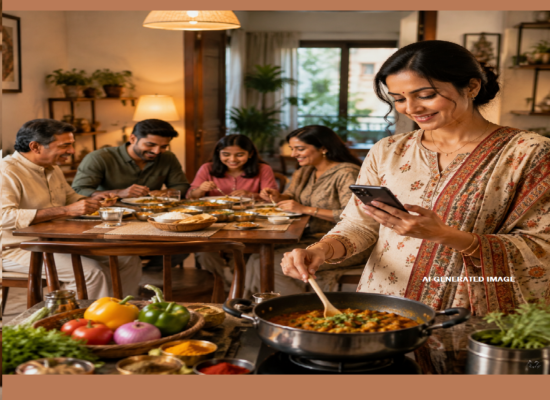
It is six-thirty in the morning, and in a modest kitchen in a quiet Indian neighbourhood, a woman is already at work. The pressure cooker hisses softly. A steel ladle taps against the side of a kadai. The fragrance of mustard seeds popping in hot oil drifts out through the window and settles over the street like a familiar greeting.
To a passerby, this is simply breakfast being made. But look closer, and something else is happening. Beside the stove sits a notebook with the day’s orders written in neat Tamil and English — twelve boxes of idli podi, four jars of homemade ghee, two orders of festival sweets for a customer two streets away. A smartphone props against the spice rack, paused mid-video, ready to record the next reel for her page. This is not just a kitchen anymore. It is a workshop. A studio. A small, humming headquarters.
Across India — in apartment kitchens in Coimbatore, in ancestral homes in Lucknow, in compact flats in Pune and bustling lanes in Kochi — this scene repeats itself in countless variations. Women who once cooked purely for their families are now cooking for customers, followers, and a growing community of people hungry for something real.
This is the quiet revolution unfolding in Indian kitchens today. It does not arrive with fanfare or breaking news. It arrives one tiffin box at a time, one Instagram reel at a time, one satisfied customer’s message at a time. And yet, taken together, these small acts are reshaping how India thinks about food, business, and the women who have always stood at the centre of both.
For generations, the kitchen was seen as the most private of spaces — a place of duty rather than opportunity. Today, that same space is becoming something far more dynamic: a launchpad. The transformation is subtle but unmistakable. The same hands that once cooked only for love now also cook for livelihood, and in doing so, are rewriting old definitions of what a “working woman” looks like.
This is the story of that shift — not of one woman, but of millions, each adding her own flavour to a larger, unfolding narrative.
(To be Contd. …)